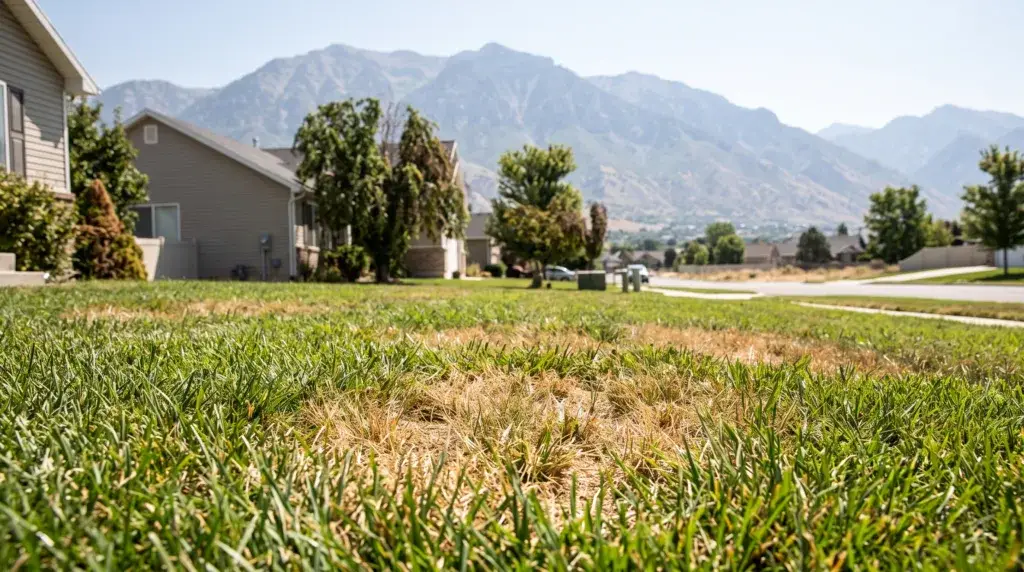
Heat, Bugs, or Fungus — How to Tell
Every July, Orem lawns start browning out — and every July, homeowners respond by watering more, which fixes exactly one of the five things that cause it. The other four get worse while the water bill climbs.
Here’s the thing about a brown lawn in Utah County: the fix depends entirely on the cause, and the cause takes about ten minutes to diagnose. Heat stress, billbugs, sod webworm, necrotic ring spot, and plain old watering mistakes all turn grass brown, and they all look about the same from the porch. Up close, they’re easy to tell apart. This guide walks you through it the same way our techs do it in your yard.
The 10-Minute Diagnosis (Do This First)
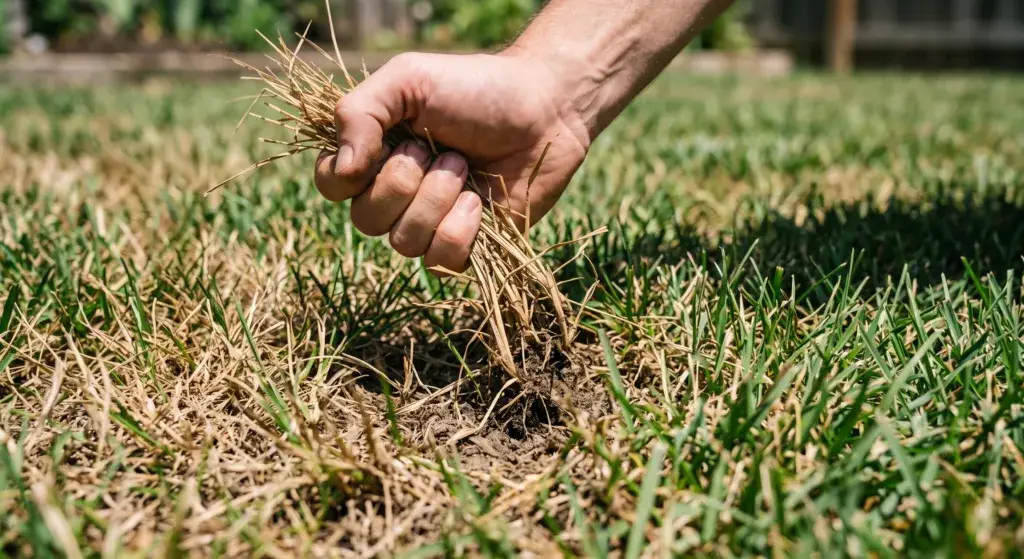
Before you change anything, run three quick tests on the brown areas:
- The tug test. Grab a handful of brown grass and pull. Healthy-but-dormant grass resists. If stems snap off easily right at the soil line — especially if the broken ends are hollow or packed with fine, sawdust-like material — you’ve got billbugs. If the turf peels back like loose carpet, you’ve got white grubs.
- The screwdriver test. Push a long screwdriver into the brown area and into a green area. If it slides into the green spot but fights you in the brown spot, the brown area isn’t getting water down to the roots — that’s a watering or soil problem, not a bug problem.
- Read the pattern. Uniform browning across sunny, exposed areas points to heat and water. Irregular expanding patches that don’t respond to water point to insects. Rings or arcs with green centers — “frog-eye” patches — point to necrotic ring spot. Small round spots with dark green halos point to the dog.
Now match what you found to the cause below.
Cause #1: Heat and Watering — The Most Common (and Most Misdiagnosed)
Orem summers are hard on Kentucky bluegrass. Long stretches near or above 95°, intense high-elevation sun, and clay-heavy soil that either sheds water or holds it in the wrong layer. The most common July mistake is watering more often instead of more deeply — daily shallow watering keeps roots in the top inch of soil, exactly where the heat is, and creates the damp surface conditions fungus loves.
The fix: water deep and infrequent. Two to three waterings per week, early morning, delivering roughly an inch to an inch and a half total. On Orem’s clay soils, run cycle-and-soak — split each watering into two shorter cycles about an hour apart, so the second round soaks in instead of running down the gutter. (And check Orem City’s current watering guide before you reprogram the clock; conservation schedules change year to year.)
One reassurance: bluegrass that browns from heat is usually dormant, not dead. The crowns are alive and the lawn greens back up when the weather breaks. Which is exactly why the tug test matters — because the next cause looks identical from the porch and is very much not dormancy.
Cause #2: Billbugs — Utah County’s Lawn Killer
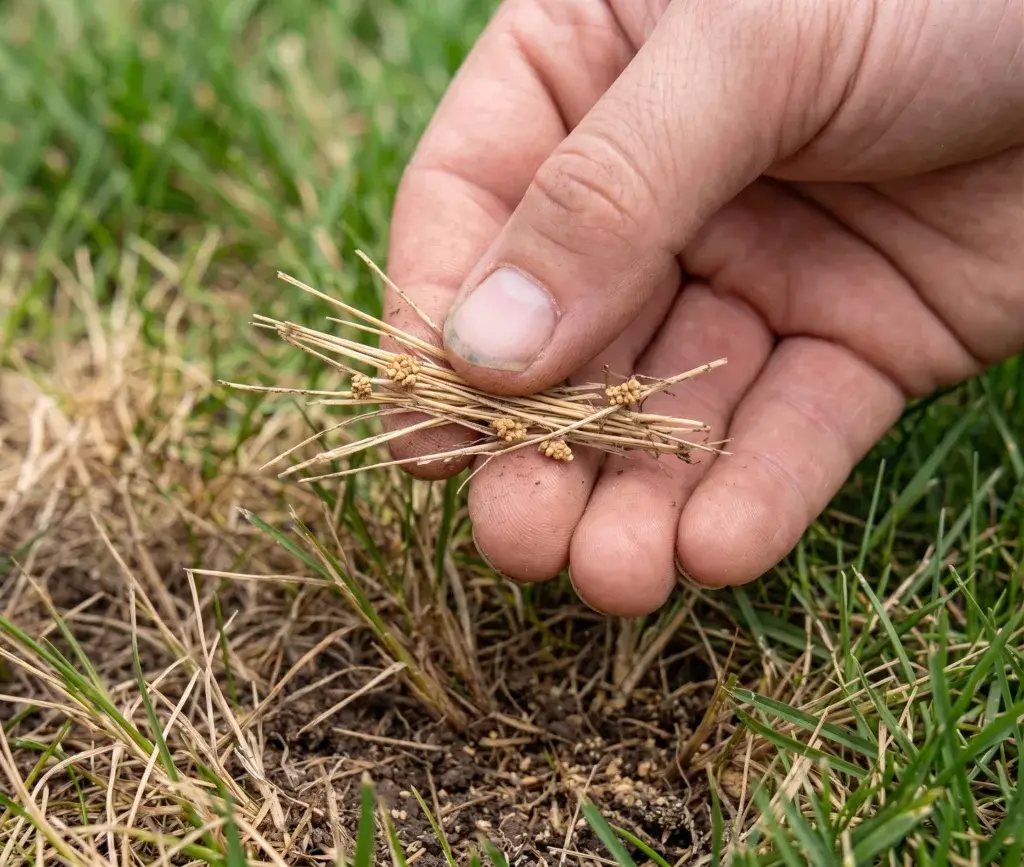
If there’s one pest built to fool Orem homeowners, it’s the bluegrass billbug. The adults are unremarkable little weevils you’d never notice. Their larvae hatch inside grass stems in late spring, eat their way down into the crowns and roots, and the damage shows up in June through August as spreading brown patches that look exactly like drought stress. Homeowners water. The patches grow. More water. More brown.
The tell is the tug test: billbug-killed grass breaks off cleanly at the crown with almost no effort, and the broken stems contain that fine, sawdust-like frass. Once larvae are in the crowns, the affected grass is not coming back — the goal shifts to stopping the spread and protecting the rest of the lawn, then repairing the dead areas in fall.
Its partner in crime, the white grub, works from below — grubs sever roots, so damaged turf lifts and rolls back like carpet, and you’ll often see skunks, raccoons, or birds tearing at the lawn to eat them. Same verdict: water won’t fix it, treatment will.
This is why our five-round program includes billbug, grub, and sod webworm treatment for prepay customers — the protection goes down before the damage window, timed to Utah County’s season rather than a national calendar. If your lawn is already showing damage, the program picks you up at the right point in the sequence.
Cause #3: Sod Webworm — The Dusk Moths
Walk your lawn at dusk. If small tan moths flush up and fly in a jerky zigzag before dropping back into the grass, you’ve likely got sod webworm. The moths themselves are harmless — their caterpillars are the problem, chewing grass blades off at night and leaving ragged brown patches that expand through July and August. Look close in damaged areas and you’ll find blades clipped off rather than wilted, sometimes with silky webbing near the soil. Like billbugs, this is an insect problem wearing a drought costume, and it’s covered under the same treatment umbrella.
Cause #4: Necrotic Ring Spot — The Frog-Eye Rings
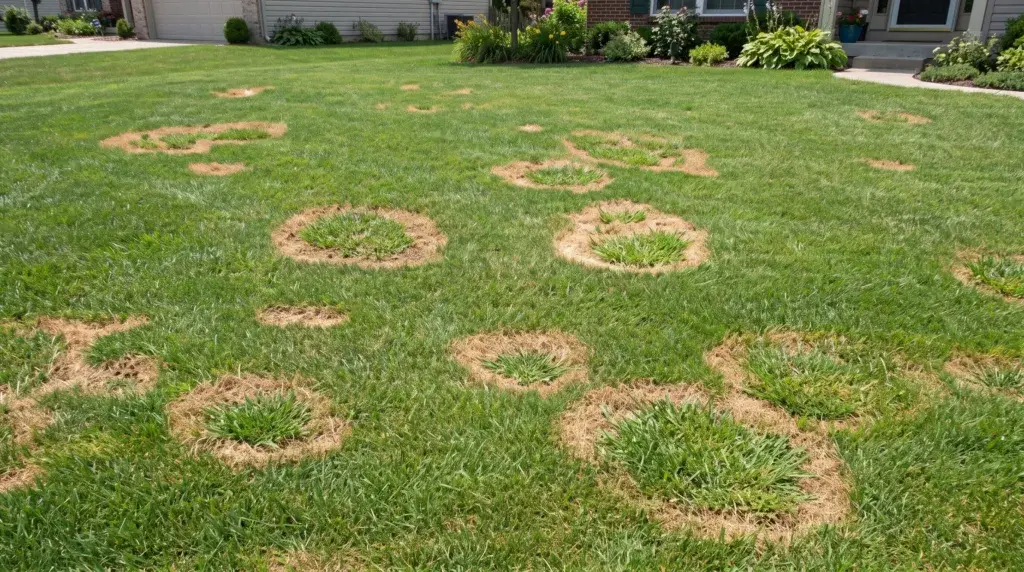
If your brown shows up as rings, arcs, or horseshoe shapes with tufts of green grass surviving in the center, that’s necrotic ring spot — a root-attacking fungal disease that hits Kentucky bluegrass lawns along the Wasatch Front, especially sodded lawns a few years old. The fungus does its root damage in the cool, wet months; the rings appear in July because the damaged roots can’t keep up with heat stress.
There’s no quick spray-and-done for this one. Management is cultural and seasonal: deep infrequent watering (with light midday syringing on the rings during heat waves), core aeration in fall, balanced fall fertilization, and overseeding damaged rings with resistant varieties. It’s a program disease — which is honestly why lawns on a structured plan rarely develop it badly in the first place.
Cause #5: Dog Spots, Dull Blades, and Scalping
The unglamorous causes deserve ten seconds. Dog spots are small round dead patches with a dark-green halo — nitrogen burn from concentrated urine, fixed by flushing with water and reseeding in fall. A dull mower blade tears grass instead of cutting it, and the shredded tips brown out lawn-wide within a day or two of mowing — sharpen the blade and the “disease” cures itself. And mowing short in July is self-sabotage: cutting below three inches exposes crowns and soil to full sun. Set the deck at 3 to 3.5 inches all summer and never remove more than a third of the blade in one mow.
What NOT to Do to a Brown Lawn in July
- Don’t throw fast nitrogen at it. Quick-release fertilizer in peak heat burns stressed turf and feeds fungal problems. One bag from the hardware store moves the needle exactly as much as you’d expect — and in July, it can move it backward.
- Don’t overseed yet. Seed sown into July heat mostly dies. Fall is repair season in northern Utah — warm soil, cooling air, low weed pressure.
- Don’t switch to daily watering. You’ll shallow the roots, raise the fungus risk, and mask the insect damage for another two weeks while it spreads.
The July Play for Orem Lawns
Diagnose first, then protect. July is Round 3 of our five-round program — PROTECT — timed for exactly this stretch: insect pressure peaking, heat at its worst, and lawns living or dying on watering habits. Prepay customers are covered by the season-long guarantee: if a treated problem comes back between rounds, we come back, no arguing.
We serve Orem and yards across Utah County, from Lehi to Spanish Fork, plus Draper and Sandy. Tell us your address and what your lawn is doing, and we’ll tell you which of the five causes you’re looking at and exactly what the fix costs — real prices on the first call, no visit required, no estimate games. Call or text 801.404.4042.
Brown Lawn FAQ
Why is my grass brown even though I water it every day?
Daily shallow watering is often the problem, not the solution — it keeps roots near the surface where July heat cooks them, and it feeds fungus. If watering isn’t the issue, do the tug test: grab a handful of brown grass and pull. If stems snap off easily at the soil line with sawdust-like material inside, that’s billbug damage, not drought — and no amount of water will fix it.
How often should I water my lawn in Utah in July?
Deep and infrequent beats daily and shallow. Most Utah County lawns do best with two to three deep waterings per week in July, early in the morning, delivering roughly an inch to an inch and a half of water total. On Orem’s clay-heavy soils, use cycle-and-soak — split each watering into two shorter runs an hour apart so water absorbs instead of running off. Check Orem City’s current watering guide for any active schedule restrictions.
Will brown grass come back on its own?
It depends on why it’s brown. Kentucky bluegrass that browned from heat and drought is usually dormant, not dead — the crowns are alive, and it greens back up when temperatures drop and water returns. Grass killed by billbugs, grubs, or necrotic ring spot will not recover, because the crowns and roots are destroyed. The tug test tells you which situation you have.
Should I fertilize a brown lawn in July?
Not with fast-release nitrogen. Pushing quick nitrogen in peak heat burns stressed turf and makes fungal problems like necrotic ring spot worse. July treatment should protect the lawn — insect control, proper watering, taller mowing — and save the heavy feeding for fall, when cooler temperatures let the lawn actually use it.
When should I aerate and overseed in Utah?
Fall — typically September into early October along the Wasatch Front. Soil is warm, air is cooling, and weed pressure is dropping, which gives new seed the best odds. Aerating or overseeding in July heat wastes seed and stresses the lawn further. Use July to diagnose and protect; use fall to repair.
Not sure which brown you’ve got? Send us your address and a photo — we’ll tell you what it is and exactly what the fix costs. Call or text 801.404.4042.
Related reading: Why Is My Utah Lawn Yellow in Spring? | Lawn Fertilization for Utah Bluegrass: The Real Guide